
UL Research Institutes (ULRI) is a leading independent, non-profit safety science organization founded in 1894. Its mission is to investigate, identify, and counter risks to human safety, public health, and the environment through scientific research.
What led up to the report
California officially allowed property insurance companies to use forward-looking catastrophe risk models on December 12, 2024.
Before this rule change, California’s Proposition 103 regulations required insurers to base rates entirely on a rolling 20-year average of past disasters.
Key Milestones in the Transition
- September 2023: Insurance Commissioner Ricardo Lara first announced the intent to shift to forward-looking climate risk models as part of his Sustainable Insurance Strategy (SIS).
- December 12, 2024: The “Use of Catastrophe Models” regulation (10 CCR §2644.4.5) formally took effect, legally permitting companies to use computerized, predictive risk models for wildfires, floods, and terrorism.
- January 2, 2025: The California Department of Insurance (CDI) officially opened the application process for insurers to submit specific risk models for regulatory review.
- July 24, 2025: The state certified its first individual wildfire catastrophe model (developed by Verisk), giving insurers a fully approved forward-looking tool to start calculating new rate structures.
The Mandatory Trade-Off
This allowance was not a free pass for insurance companies. In exchange for using these predictive future risk models to adjust rates, the CDI mandated that insurers must write or maintain at least 85% of their statewide market share in high-risk, wildfire-distressed areas. This rule was designed to force insurance companies back into vulnerable communities they had previously fled.
When we talk about the “science of wildfire,” we often ask whose science it is.
This report takes a deep dive into the science and the risks.
Report Background
Wildfires increasingly threaten lives, homes, infrastructure, and natural resources. Reducing that risk requires knowing where fires may start and spread, who and what is exposed, how vulnerable those assets are, what the consequences could be, and which actions best reduce risk. Wildfire science has advanced a great deal, but the field now has a confusing mix of models, methods, assumptions, and datasets. No single model covers the full risk picture, from natural landscapes to rural communities to cities.
The Exercise
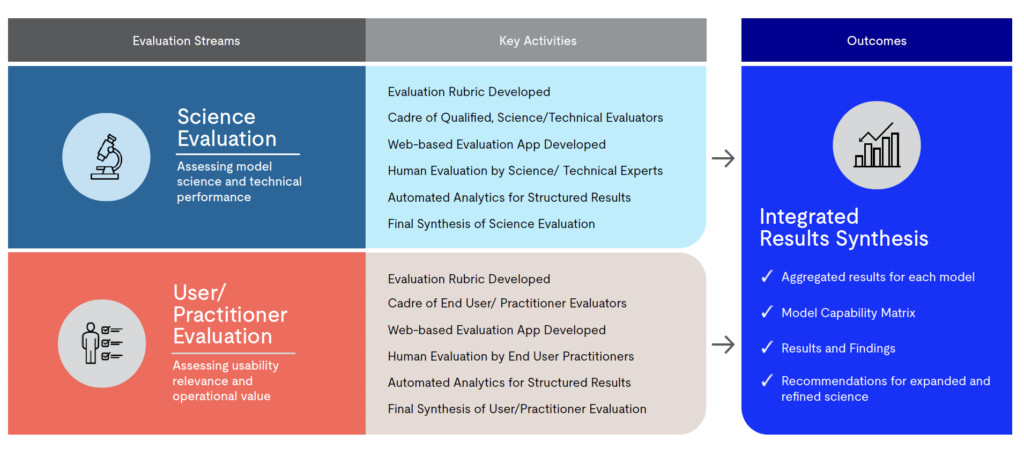
The 2026 Wildfire Risk Modeling Exercise was an open, collaborative, non-competitive effort to understand this landscape. Participating organizations ran their models on shared, semi-synthetic scenarios representing wildland, wildland-urban interface, and urban conditions. Everyone used the same datasets, infrastructure, and documentation. Both scientists and practitioners evaluated the results, looking at technical rigor, usefulness, transparency, and relevance to real decisions. The goal was not to rank models or pick a “best” one, but to understand what each approach does well, find gaps, and explore ways to make models work together.
Intended Use of the Report
This report serves as a resource for understanding the current capabilities, limitations, and future opportunities of wildfire risk modeling. It is designed to help stakeholders:
- Select and apply wildfire risk models appropriately based on their intended use case.
- Better understand the strengths and limitations of existing modeling approaches.
- Identify opportunities to combine models to improve accuracy, precision, and decision-support value.
- Inform community, infrastructure, and operational risk management decisions.
- Guide future research, development, and investment priorities.
- Advance collaboration, interoperability, and open-science approaches across the wildfire risk modeling community.
The report intentionally does not identify a single “best” model. Instead, it aims to clarify where different models add value, where gaps remain, and how the wildfire risk modeling community can work together to produce more actionable, scientifically defensible wildfire risk intelligence.