
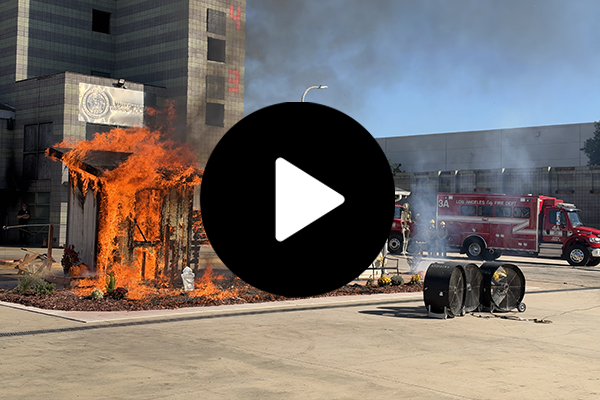
Watch Full Video Below
On October 26, 2026, the Insurance Institute for Business & Home Safety (IBHS) and CalChiefs Fire Marshal Section held a live side-by-side burn demonstration to show how proven home and landscaping mitigation strategies will reduce home ignition and improve wildfire resilience.
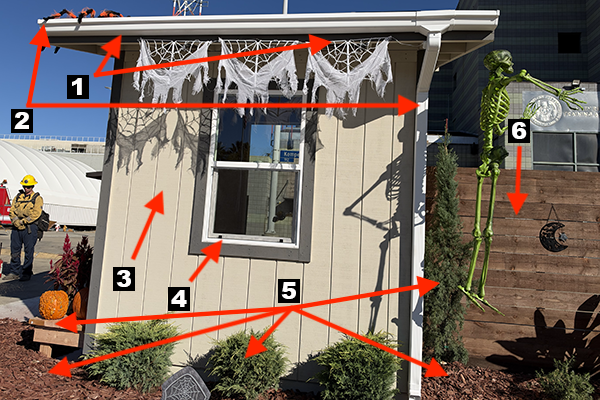
Constructed to mimic most of our homes
- Open eaves
- Vinyl Gutter and downspout
- Combustible siding
- Single-pane windows
- Combustible vegetation and items in Zone 0
- Wooden fences and gates attached to our homes
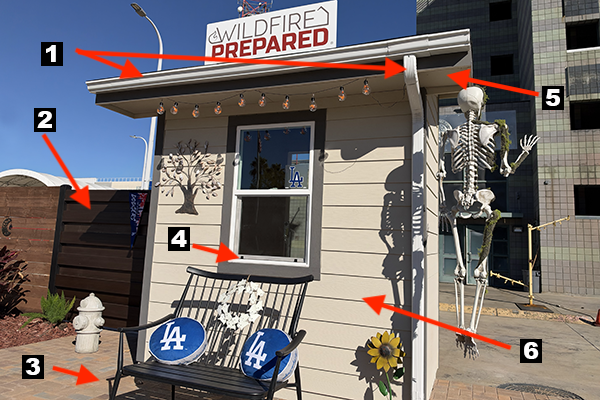
Constructed with Wildfire Prepared Home Recommendations
- Metal Gutter and downspout
- Non-combustible fence
- Non-combustible 5-foot Zone 0
- Double-pane tempered windows
- Enclosed eaves
- Non-combustible siding
We cannot prevent every fire, but together, we can change the outcome.
— Daniel Berlant, California State Fire Marshal (CAL FIRE)
Two side-by-side structures were constructed:
– The one on the left was constructed using traditional building materials that are found in most of our homes, with no Zone 0 recommendations followed.
– The one on the right was constructed using Enhanced IBHS Wildfire Prepared Home recommendations.
Both homes had the same vegetation in front of the homes.
A firefighting hand tool, called a drip torch, was used to ignite the vegetation and mulch in the exact same locations in front of the structures. Drip torches are used to “fight fire with fire” and consume fuel ahead of a fire. The same amount of fire was put down in front of the two structures, so both would receive equal amounts of fire.
Cushions on the bench in front of the Wildfire Prepared Home were removed before ignition, just as all combustible items should be removed from within five feet of the home during red flag days. Your trash cans, pillows, and all combustible items should be brought inside on red flag days.
You will note in the video that the flames are going straight up. There was no wind. IBHS did have three large fans but they were not needed for the demonstration. The humidity, of about 40 percent, was low enough that no extra wind was necessary, and as you can see in the video, the structure took less than five minutes to ignite. The well-hydrated vegetation dried out and ignited very quickly.
The mulch and vegetation within five feet of the home brought the fire to the structure on the left, and quickly ignited the vinyl gutter and wood siding.
The structure on the right, even though it experienced the same threat, had a non-combustible five-foot zone around the home, called Zone 0. Zone 0 was able to keep the spot fires away from the home.
The mulch also brought the ground fire to the wood fence attached to the structure on the left. The fence ignited almost immediately, creating a fire pathway to the left structure.
In less than five minutes small spot fires had the open eaves on the left structure engulfed with flames.
These are very small structures with little vegetation, and there was no wind, but embers could still be seen rising into the air looking to land on some kindling somewhere else in the community.
The fire behavior on the right corner of the house shows how local wind and structures can create their own threats to accelerate the fire.
We highly recommend you watch the video to understand fire behavior and why Home Hardening and Defensible Space, things you can do, are so important.
Click on the link below to view the video and listen as Steve Hawks, Senior Director for Wildfire, and Anne Cope, PhD, P.E., Chief Engineer, at IBHS, walk us through the burn.
Thanks to IBHS and CalChiefs Fire Marshal Section for putting on this excellent demonstration of how science-based Home Hardening and Defensible Space principles make your home more resilient to wildfire.
Our communities and fire crews deserve evidence-based decisions during a wildfire.
Do your part. Be ready for the next wildfire.
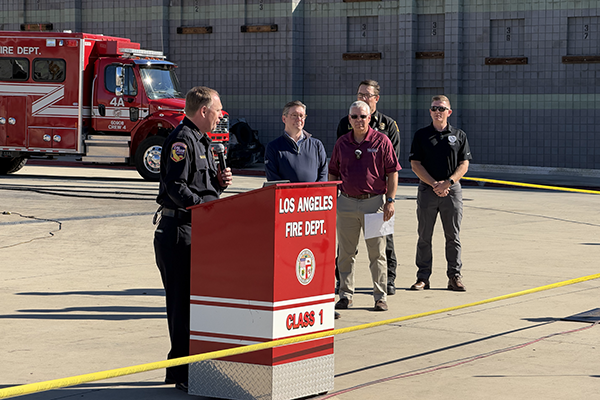
Daniel Berlant, CA State Fire Marshall
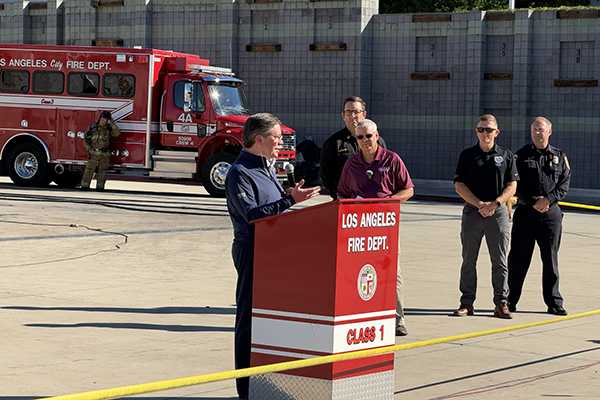
Roy Wright, President and CEO of IBHS
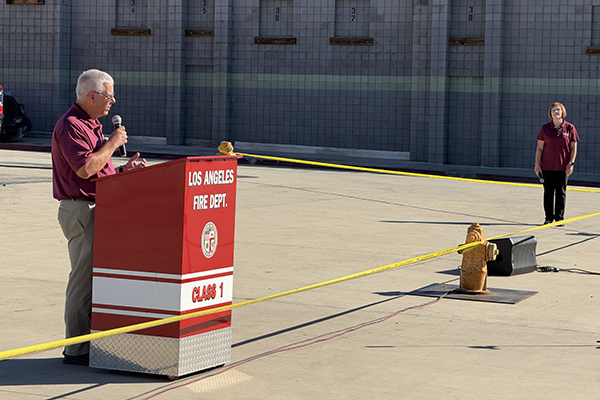
IBHS’s, Steve Hawks, Senior Director for Wildfire, and Anne Cope, Chief Engineer
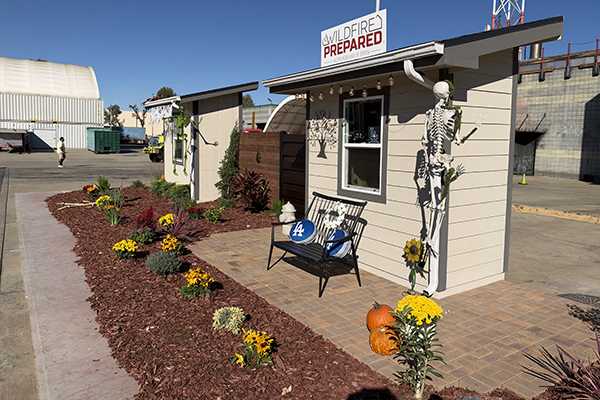
Non-combustible 5-foot Zone 0 clearly visible
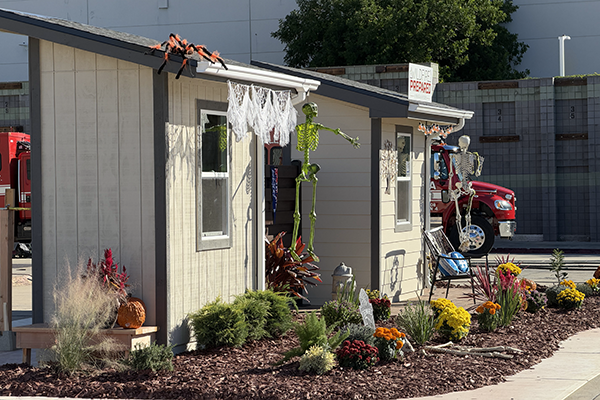
Combustible 5-foot Zone 0 clearly visible
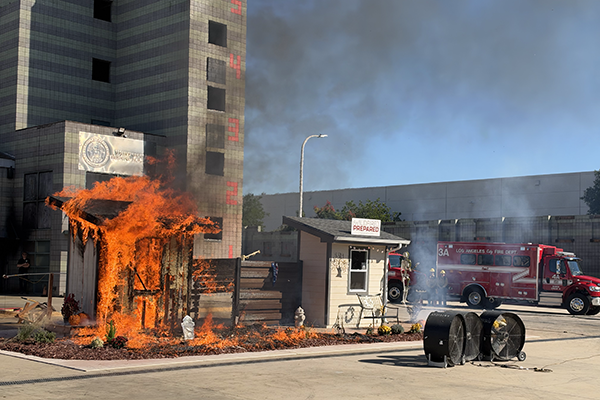
No wind, no fans—10 minutes in, the left structure was totally engulfed
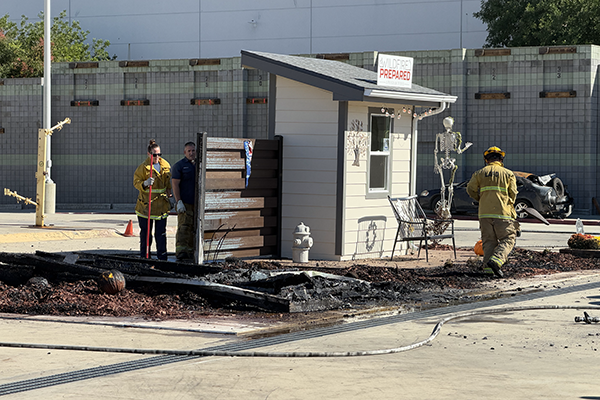
Examining the science of a Wildfire Prepared Home
CLICK ON THE IMAGE BELOW to view the video and listen as Steve Hawks, Senior Director for Wildfire
and Anne Cope, PhD, P.E., Chief Engineer at IBHS, walk us through the burn.