
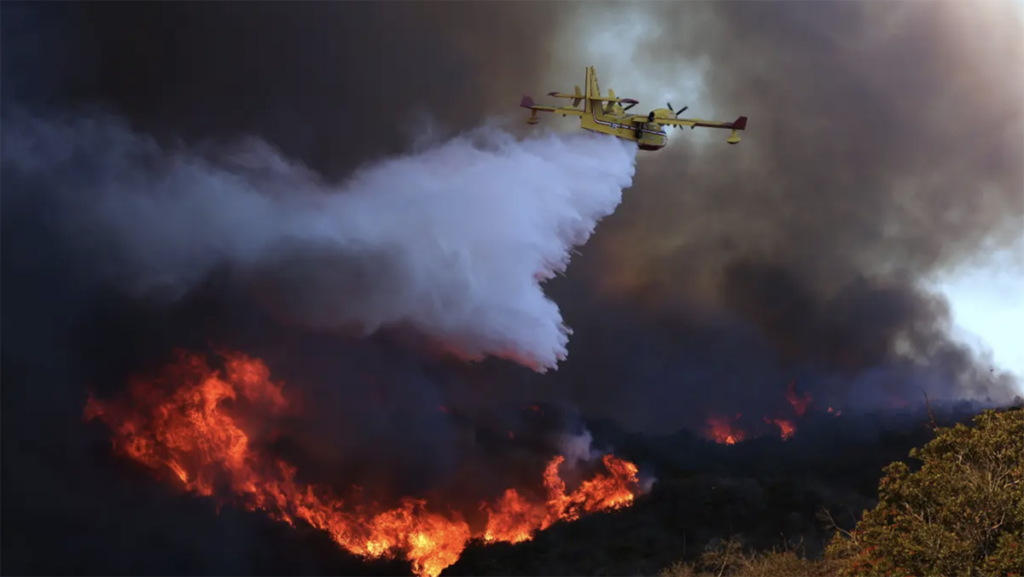
A firefighting plane dumps water on the Palisades fire on Jan. 7, 2025.
Photo courtesy: Brian van den Burg/Los Angeles Times
A sweeping new review of the January 2025 Los Angeles fires concludes that no single agency or decision explains the destruction. Instead, it describes a system that was never designed for fires like these.
The roughly 723-page report was released October 2, 2026. It completes an analysis ordered by Gov. Gavin Newsom and conducted by the Fire Safety Research Institute, part of UL Research Institutes. The institute’s first report, published last November, laid out a timeline beginning Jan. 7, when the Palisades and Eaton fires ignited less than eight hours and about 30 miles apart. This second report turns to the policy gaps the fires exposed.
A system overwhelmed
The human toll frames the findings. The two fires killed 31 people and destroyed more than 16,000 structures. The report finds that the fires overwhelmed a system never built for wind-driven conflagrations. That conclusion raises an uncomfortable follow-up: if responsibility is spread across an entire system, who is responsible for fixing it?
Altadena: where most of the deaths occurred
The report describes breakdowns inside the command structure. It found that communication gaps between county fire and sheriff officials caused a lag in response. At a critical moment, virtually all other fire resources were still east of Lake Avenue, spread over several miles. Even if field reports of burning homes had reached the Rose Bowl base, investigators found the incident command there was disorganized and chaotic.
The report also challenges the account some Eaton officials have maintained. Officials have said they did not know the fire was moving west, but FireGuard maps in the report show it beginning to shift westward as early as 9 p.m. County command did not realize the fire had swept through west Altadena until daylight on Jan. 8, by which time most structures there had already been affected.
The Los Angeles Times reported that the findings confirm its earlier reporting, particularly about how a historically Black neighborhood received delayed evacuation alerts.
Palisades: dysfunction at the city level
The Palisades fire response had its own problems. Incident command was forced to relocate three times as command posts were inundated by fleeing residents and eventually by the fire itself. Coverage of the report also points to city dysfunction that hampered the response.
Conditions beyond the system’s design
The report does not blame the response alone. It describes conditions that were already exceptionally dangerous and volatile, with chaos and poor communication making evacuations, rescues and firefighting harder still. Earlier findings from this review noted that a massive multi-agency response was ultimately overmatched by extreme fire behavior, with downed trees, poles and wires blocking evacuation and response routes.
What comes next
For survivors, the report arrives after a series of official investigations that, in the view of many, glossed over or downplayed failures by city and county agencies. This review is being described as the most candid and detailed yet.
Its central difficulty is also its central finding. When failures are distributed across fire departments, sheriff’s offices, city and county governments, and emergency alert systems, no one body owns the fix. Whether Sacramento, Los Angeles County, the city, or some combination takes responsibility for reforms is the question now facing officials, and for the families of the 31 people who died, it is the one that matters most.